Content:
SHARE:


Subscribe and don't miss anything important
Don't worry, we don't spam 😍
Most “best Shopify growth agencies” lists are written for brands that already have serious revenue, large teams, and enough budget to test multiple channels at once.
That is not the reality for most Shopify stores under $1M in annual revenue.
At this stage, every dollar matters. You do not need a massive enterprise agency, a complex Shopify Plus rebuild, or a strategy deck that takes three months to turn into action. You need practical growth work that improves the store, brings better traffic, converts more visitors, and helps you understand what is actually profitable.
That is where choosing the right Shopify growth agency becomes important.
For brands under $1M, the right agency is not necessarily the biggest agency. It is the one that understands early-stage ecommerce constraints: limited budget, small teams, inconsistent data, founder involvement, and the need to make channels work before scaling spend.
This guide breaks down what a Shopify growth agency should actually do, which agencies are worth knowing in 2026, and how smaller Shopify brands should choose the right partner.
What Is a Shopify Growth Agency?
A Shopify growth agency helps e-commerce brands increase revenue through a mix of traffic, conversion, retention, and strategy.
That can include:
- Shopify PPC
- Google Ads
- Meta Ads
- SEO
- Email marketing
- Conversion rate optimization
- Product page improvements
- Landing pages
- Collection page optimization
- Analytics and tracking
- Creative testing
- Growth strategy
The key difference is that a Shopify growth agency should not look at one channel in isolation.
A Shopify PPC agency may focus mainly on paid ads. A Shopify SEO agency may focus mainly on rankings and organic traffic. A Shopify ecommerce agency may focus on store design or development. A growth agency should connect all of those areas around the same question:
What will actually help this store grow profitably?
For brands under $1M, that question matters more than anything else.
Why Brands Under $1M Need a Different Type of Agency
A Shopify brand doing $200K, $500K, or $900K per year has different needs than a brand doing $20M.
At this stage, the problem is usually not “how do we scale from $5M to $20M?” The problem is more basic:
- Which channel should we focus on first?
- Are our ads profitable?
- Is our store converting well enough?
- Do our product pages explain the offer clearly?
- Are we getting enough repeat purchases?
- Is SEO worth investing in yet?
- Are we tracking revenue correctly?
- Should we spend more on ads or fix the website first?
A large agency may not be built for these questions. They may require high retainers, long onboarding, and a level of data maturity your store does not have yet.
A smaller Shopify growth agency, or an e-commerce agency used to working with founder-led brands, can often be a better fit.
Under $1M revenue, you need a partner who can prioritize. Not everything matters equally. The right agency should tell you what to do now, what to delay, and what is not worth paying for yet.
What the Best Shopify Growth Agencies Do Well
Before looking at agencies, it is worth defining what “good” actually means.
For a Shopify brand under $1M, a strong agency should be able to help with five things.
1. They Understand Unit Economics
A good agency should ask about margins, average order value, repeat purchase rate, shipping costs, and target customer acquisition cost before recommending channels.
If an agency talks about scaling ads before understanding your margins, that is a red flag.
For example, a 3x ROAS may be profitable for one Shopify brand and unprofitable for another. Without understanding gross margin and customer lifetime value, campaign performance numbers can be misleading.
2. They Know Shopify Specifically
Shopify has its own structure, apps, checkout behavior, product feed issues, collection pages, URL structure, and tracking quirks.
A general digital marketing agency may understand ads or SEO, but that does not mean they understand Shopify growth.
A real Shopify ecommerce agency should know how product pages, collections, Shopify apps, email tools, analytics, and paid channels work together.
3. They Can Prioritize Channels
Under $1M revenue, you usually cannot do everything at once.
You may need to choose between SEO and PPC. Or between Meta Ads and Google Ads. Or between email flows and CRO. Or between product page work and new content.
A good Shopify growth agency should help you make those tradeoffs. They should not sell every service just because they offer it.
4. They Improve the Store, Not Just Traffic
Traffic is only useful if the store can convert it.
If your product pages are weak, your offer is unclear, or your site has trust issues, increasing ad spend may only make the problem more expensive.
The best Shopify growth agencies look at the store itself: product pages, collection pages, navigation, checkout friction, reviews, shipping information, guarantees, and mobile experience.
5. They Report on Business Outcomes
Clicks, impressions, traffic, and rankings are useful signals. But they are not the final goal.
For Shopify brands, the real metrics are:
- Revenue
- Profitability
- ROAS
- CPA
- Conversion rate
- Average order value
- Repeat purchase rate
- Email revenue
- Organic revenue
- New customer acquisition cost
If reporting does not connect to revenue, it is not enough.
Top 5 Shopify Growth Agencies for Brands Under $1M Revenue
This is not a pay-to-play directory. The agencies below are included because they are relevant to Shopify, ecommerce, growth marketing, paid media, or founder-led brands. The best fit depends on your budget, stage, and internal resources.
1. UM Marketing
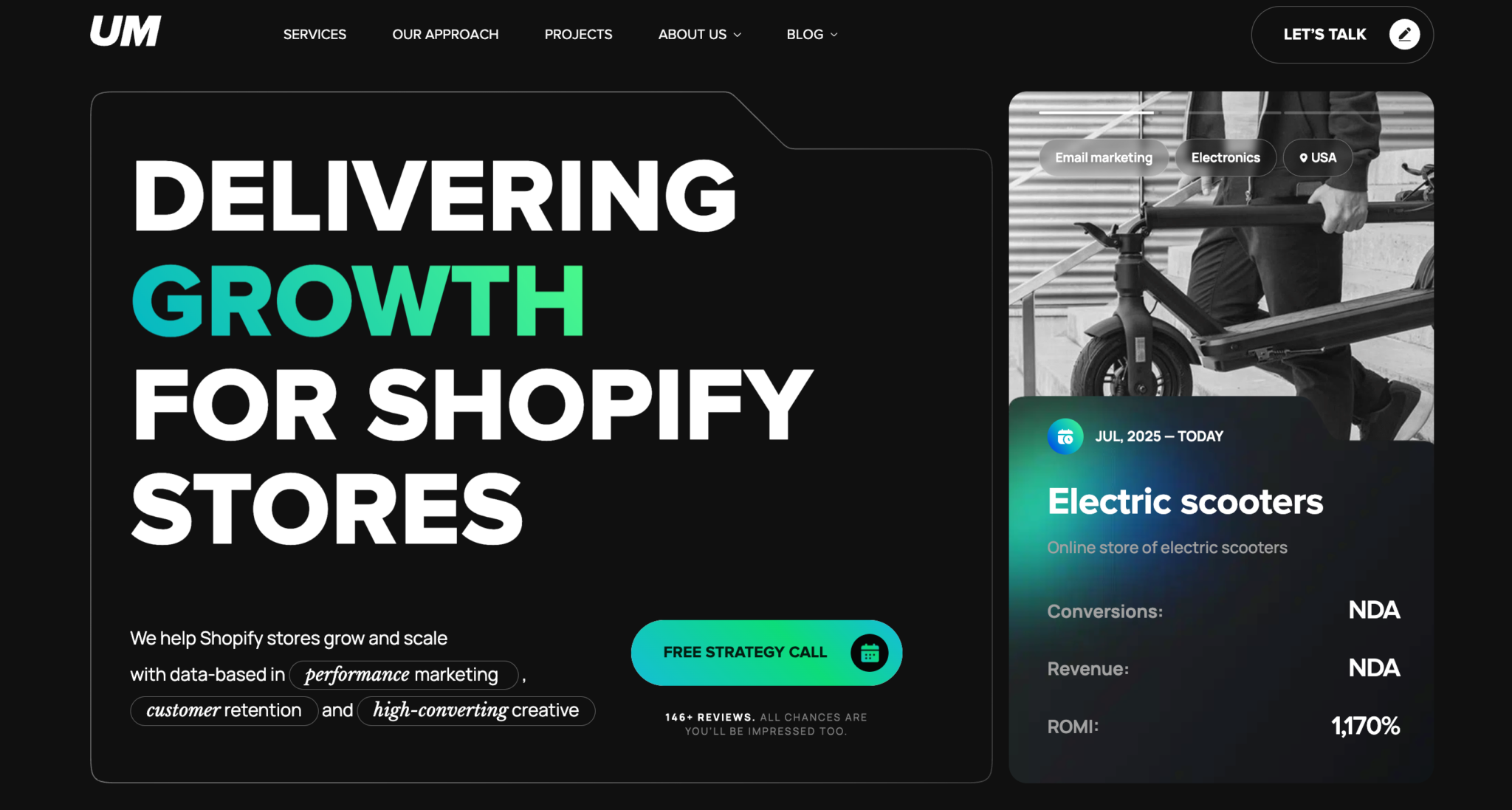
UM is a strong fit for Shopify brands under $1M because the agency is built around ecommerce growth rather than one isolated service.
For smaller Shopify brands, this matters. You may not need separate agencies for PPC, SEO, email, and conversion strategy. You likely need one partner who can look at the whole picture and decide what should be fixed first.
UM works with Shopify brands across paid media, SEO, email, and growth strategy. That makes the agency useful for stores that are still trying to understand which channels are worth scaling.
For example, a store may think it needs more Google Ads spend, but the real issue may be weak product page copy or poor collection page structure. Another store may want SEO content, but the faster win may be Klaviyo flow optimization or PPC campaign cleanup.
That is the benefit of working with a Shopify growth agency that understands multiple growth levers.
Best fit for: Founder-led Shopify brands that want practical growth execution across paid ads, SEO, email, and store optimization.
Good for:
- Shopify PPC
- Google Ads and Meta Ads
- E-commerce SEO
- Shopify email marketing
- Product and collection page improvements
- Growth strategy
- Brands under $1M that need clear prioritization
Potential limitation: If you only need a Shopify theme redesign or complex custom development, a development-focused Shopify agency may be a better fit.

2. Common Thread Collective
Common Thread Collective is one of the more recognized e-commerce growth agencies, especially in the DTC space. The agency is known for paid media, creative, forecasting, and e-commerce strategy.
For Shopify brands with enough budget to invest seriously in paid acquisition, CTC can be a strong partner. Their approach is especially relevant for brands that need help connecting ad spend with financial planning and growth targets.
However, smaller brands under $1M should evaluate fit carefully. Larger ecommerce agencies may have higher retainers or may be better suited to brands with more mature data, larger budgets, and clearer product-market fit.
Best fit for: DTC brands with strong fundamentals and enough ad budget to support structured growth work.
Good for:
- Paid media
- Creative testing
- E-commerce growth strategy
- Forecasting
- DTC scaling
- Brands preparing for more aggressive growth
Potential limitation: May be more advanced or expensive than necessary for very early-stage Shopify stores.
3. Hawke Media
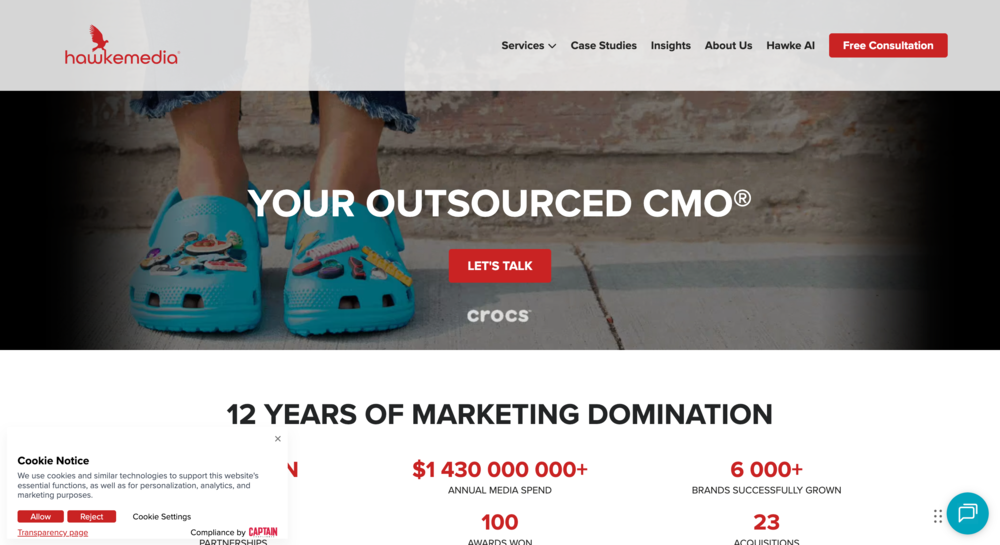
Hawke Media is a broad ecommerce and digital marketing agency that works with brands across multiple channels. Their model is flexible compared with some traditional agencies, which can be useful for smaller businesses that do not want a heavy, long-term commitment immediately.
For Shopify brands under $1M, Hawke can be a good fit when the brand needs access to several marketing services but is not ready to build an internal team.
Because Hawke is not only Shopify-specific, it is important to make sure the team assigned to your account has real e-commerce and Shopify experience. The agency may offer many services, but the quality of fit depends on who is actually managing the work.
Best fit for: Small-to-mid-sized ecommerce brands that want flexible marketing support across several channels.
Good for:
- Paid media
- Email marketing
- Strategy
- Creative
- Social
- Fractional marketing support
- Brands that need broader marketing execution
Potential limitation: Because the agency is broad, Shopify brands should confirm the team has direct Shopify experience.
4. Disruptive Advertising
Disruptive Advertising is well known for paid media, especially PPC. For Shopify brands that already know paid acquisition is the main growth priority, this type of agency can be useful.
A strong Shopify PPC agency can help clean up Google Ads, improve campaign structure, build better conversion tracking, and reduce wasted spend. This is especially important for brands under $1M because poor ad efficiency can eat through budget quickly.
Disruptive may be a better fit for stores that already have a functioning website and clear offer, but need stronger paid media execution.
Best fit for: Shopify brands that need paid search, paid social, or PPC account improvement.
Good for:
- Google Ads
- Meta Ads
- PPC strategy
- Paid media audits
- Conversion tracking
- Lead and e-commerce campaigns
Potential limitation: If your biggest problem is product positioning, SEO, email retention, or Shopify site structure, a PPC-first agency may not solve the full issue.

5. Charle
Charle is a Shopify-focused agency that works on ecommerce design, development, retention, and growth. For brands that need the store experience improved alongside marketing, a Shopify-specialist agency like Charle can make sense.
This is useful for brands under $1M that have outgrown a basic Shopify theme or need better UX, landing pages, customer journeys, and retention strategy.
The advantage of a Shopify ecommerce agency is platform depth. They understand how the store itself affects growth, not only how traffic gets to the store.
Best fit for: Shopify brands that need better store experience, ecommerce UX, and growth support.
Good for:
- Shopify design
- Shopify development
- Email and retention
- Conversion-focused site improvements
- E-commerce UX
- Store experience strategy
Potential limitation: If the main need is aggressive PPC management or SEO content production, compare their growth scope carefully.
Should Brands Under $1M Hire an Agency at All?
Not always.
If your Shopify store is still testing products, has inconsistent sales, or has no clear customer demand yet, an agency may be too early. In that case, your money may be better spent on product, creative, customer research, or basic setup.
You should consider hiring a Shopify growth agency when:
- You have consistent monthly sales
- You know which products customers actually buy
- You have some traffic but conversion is weak
- Paid ads are running but inefficient
- You have customer data but no retention strategy
- You are too busy to manage growth channels yourself
- You need someone to prioritize what to fix first
You may not need an agency yet if:
- You have no proven product
- You are still changing niches frequently
- You cannot afford at least a few months of testing
- You have no margin to support paid acquisition
- You are looking for guaranteed results without risk
A good agency can improve a real business. It cannot magically create demand where none exists.
Agency vs Freelancer vs In-House
For Shopify brands under $1M, the right option depends on your stage.
A freelancer can be a good fit if you need:
- One channel handled
- Basic Klaviyo flows
- Google Ads cleanup
- Meta Ads testing
- Shopify SEO fixes
- Affordable execution
An agency makes sense if you need:
- Strategy plus execution
- Multiple channels connected
- Reporting and prioritization
- PPC, SEO, email, and CRO working together
- A clearer growth plan
- More experience than one freelancer can provide
In-house usually makes sense later, when:
- You have enough work for a full-time marketer
- Your processes are already clear
- You need daily brand involvement
- You can afford salary, tools, and management
- You know which channels are already working
Most smaller Shopify brands should not rush into hiring in-house. A good agency can help prove which channels deserve permanent investment first.
Questions to Ask Before Hiring a Shopify Growth Agency
Before signing with any Shopify ecommerce agency, ask questions that reveal how they think.
- Have you worked with Shopify brands at our revenue stage?
- What would you prioritize first based on our current store?
- Do you understand our margins and target CPA?
- Which channels do you think we should not invest in yet?
- Who will actually manage our account day to day?
- How do you report on revenue and profitability?
- Do you work inside our ad accounts, or do you create separate accounts?
- What happens if a channel does not perform?
- What do you need from us to succeed?
- How long before we should expect useful data?
The best agencies will not promise easy wins without looking at your store, numbers, and current channel performance.
Red Flags to Watch For
Be careful if an agency:
- Guarantees revenue before reviewing your data
- Pushes ad spend without understanding margins
- Talks only about traffic, not conversion
- Has no Shopify-specific experience
- Cannot explain what they would prioritize first
- Sells every service as equally urgent
- Does not clarify ownership of ad accounts and data
- Uses the same strategy for every e-commerce brand
- Avoids discussing profitability
- Locks you into a long contract without a clear plan
For brands under $1M, choosing the wrong agency is expensive. It is not just the retainer — it is the wasted time, wasted ad spend, and missed learning.
What a Good First 90 Days Should Look Like
A strong Shopify growth agency should not spend the first 90 days only “learning the brand.”
The first month should usually focus on audit, tracking, quick wins, and prioritization. That may include reviewing analytics, ad accounts, product pages, email flows, SEO issues, and conversion problems.
The second month should focus on implementation. This could include PPC restructuring, product page improvements, Klaviyo flow updates, SEO cleanup, or new landing pages.
The third month should focus on testing and early scaling. By then, you should have clearer data on what is working, what needs more time, and what should be stopped.
For smaller Shopify brands, speed matters. The goal is not to do everything. The goal is to learn quickly and put a budget behind the most promising growth levers.
Conclusion
The best Shopify growth agencies for brands under $1M are not always the biggest names in ecommerce.
At this stage, you need a partner who understands constraints. Someone who can tell you what to fix first, which channels are worth testing, and where your money is likely being wasted.
UM is a strong fit for founder-led Shopify brands that need paid ads, SEO, email, and growth strategy connected in one place. Common Thread Collective and Hawke Media can be good options for broader ecommerce growth support. Disruptive Advertising is worth considering when PPC is the main priority. Charle is a good fit when the Shopify store experience and growth need to be handled together.
The right choice depends on where your store is now.
If you are under $1M in revenue, do not hire an agency because they sound impressive. Hire the one who can help you make better growth decisions with the budget, data, and team you actually have.
Want to understand what your Shopify store should prioritize first? UM Marketing helps Shopify brands identify the highest-impact growth opportunities across PPC, SEO, email, and conversion — so you know where to invest before you scale.
FAQ: Shopify Growth Agencies
What is a Shopify growth agency?
A Shopify growth agency helps ecommerce brands grow revenue through channels like PPC, SEO, email marketing, CRO, analytics, and store optimization. Unlike a single-channel agency, a growth agency should connect traffic, conversion, and retention into one strategy.
What is the best Shopify growth agency for brands under $1M?
The best Shopify growth agency depends on your current needs. UM is a strong fit for founder-led Shopify brands that need PPC, SEO, email, and growth strategy connected. Other agencies may be better for larger paid media budgets, Shopify development, or specialized services.
Should a small Shopify brand hire a PPC agency?
A small Shopify brand should hire a Shopify PPC agency only if the store has clear product demand, enough margin to support paid acquisition, and tracking in place. If the website does not convert or the offer is weak, fixing the store may be more important than increasing ad spend.
What should I look for in a Shopify e-commerce agency?
Look for Shopify experience, clear reporting, understanding of margins, channel prioritization, and proof that they can work with brands at your stage. Avoid agencies that only talk about traffic or promise results before reviewing your data.
How much should a Shopify brand under $1M spend on an agency?
It depends on revenue, margins, and growth goals. Many smaller Shopify brands start with focused retainers for one or two priority channels rather than hiring a large full-service agency immediately. The key is making sure the retainer leaves enough budget for ad spend, creative, tools, and testing.
Is it better to hire a freelancer or a Shopify growth agency?
A freelancer can work well for one clear task, like setting up Klaviyo flows or managing one ad channel. A Shopify growth agency is usually better when you need strategy, multiple channels, reporting, and prioritization across the full store.