
Content:
SHARE:


Subscribe and don't miss anything important
Don't worry, we don't spam 😍
This case study breaks down how we revived a stalled digital education brand — rebuilding its entire Meta Ads system from the ground up and growing monthly sales from ~$1,800 to $5,529, with ad spend scaled 5× while maintaining profitable ROAS.
Client’s Story
Our client is an online education and digital products brand operating in the entrepreneurship niche. The business built strong early traction in 2023, selling vendor lists, business planners, and startup resources aimed at beginner entrepreneurs.
After an initial viral phase, however, growth stalled. Market trends shifted, the ad strategy aged out, and revenue began a slow, painful decline. The brand had a large social media following and proven product-market fit — but no system to turn that into consistent, scalable sales.
The team came to us with one clear mandate: rebuild the Meta Ads system and restore profitable, sustainable growth.
Challenges We Faced
Despite strong historical performance and an engaged audience, the ad account had deteriorated significantly by the time we took over. The campaign structure was outdated, the product lineup was scattered, and the website’s conversion flow hadn’t kept pace with paid traffic standards.
After an initial audit, we identified five core problems:
- Outdated ad strategy: The entire approach was built on 2023 trends that no longer resonated with the target audience.
- Unfocused product promotion: Too many products were running simultaneously with no prioritization or clear winner to scale behind.
- Unconverted paid traffic: The website wasn’t optimized for the buying journey of users arriving from ads — high drop-off, low intent completion.
- No structured testing system: Meta Ads were running on feel, not on a documented creative testing framework.
- Minimal budget headroom: After a prolonged unprofitable period, the brand could only afford a very small initial testing budget — meaning every dollar had to count.
The combination of a depleted budget and structural stagnation meant we couldn’t simply “spend more.” We had to rebuild smarter first.
The Growth Method
Product Analysis & Prioritization
We started by reviewing the full product catalog and identifying the highest-potential items — not by gut feel, but by analyzing demand signals, price-to-perceived-value ratios, and competitor positioning. Rather than promoting everything at once, we selected a focused set of lead products to validate first.
Ad Strategy Rebuild
We designed a new Meta Ads structure from scratch: a systematic testing framework with defined creative angles, controlled budget progression, and clear scaling criteria. The goal was to eliminate guesswork and replace it with a repeatable, data-driven system.
Creative Refresh
The existing creatives were visually dated and no longer matched what was performing in the market. We replaced them with modern formats — aligned with current competitor trends and audience expectations — and introduced multiple creative angles to test simultaneously.
CRO Improvements
We analyzed the full website experience from the perspective of a paid traffic visitor and provided a structured set of conversion rate optimization recommendations: product positioning, page copy clarity, checkout flow friction points, and trust signal placement.
Budget Scaling System
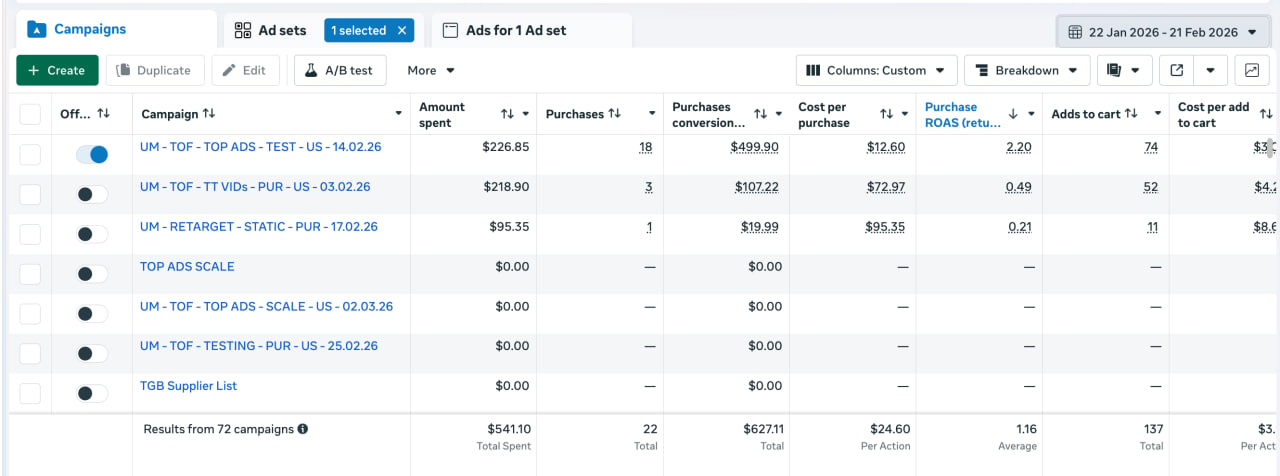
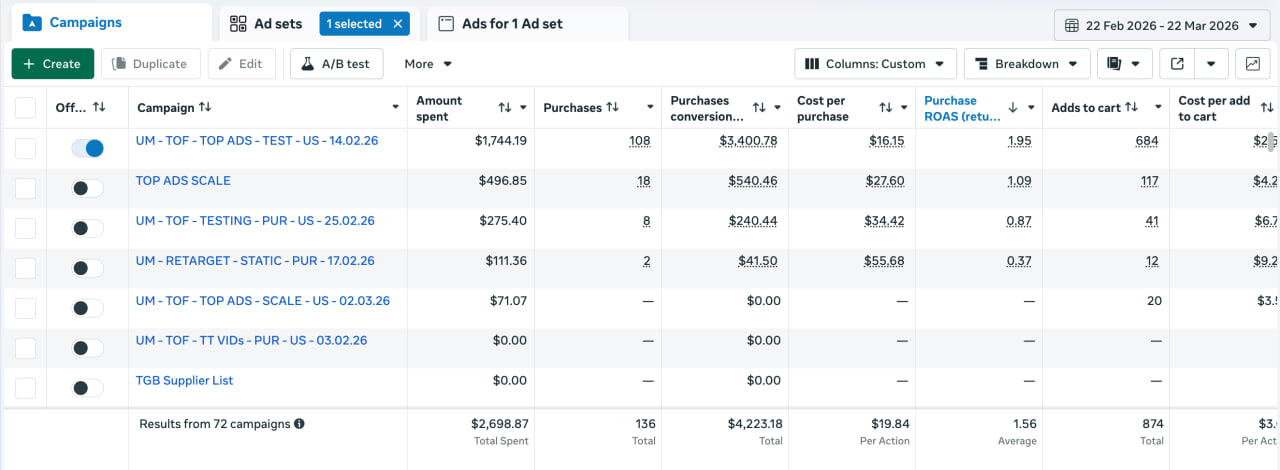
Given the profitability constraints, we started with a minimal spend of ~$540/month. Once winning creatives and products were confirmed through controlled testing, we gradually scaled the budget — only after each stage demonstrated stable ROAS — eventually reaching ~$2,698/month.
Competitor Research
We studied the current market leaders in the digital education and entrepreneurship niche and rebuilt our ad approach based on what is working now, not on what generated results two years ago. This informed everything from creative formats to offer framing and audience targeting.
The Roadblock
After the initial wins, we hit a natural ceiling. The testing phase validated clear winners, but scaling the budget too aggressively risked destabilizing the ROAS before the account structure was ready to support it. Meta’s algorithm, when given more budget without tight creative and audience constraints, tends to broaden targeting into lower-intent segments — which is exactly what had caused the original decline.
We recognized that to scale profitably, we needed more than a bigger budget. We needed stronger creatives and tighter campaign architecture to guide the algorithm toward the right buyers.
The Fix: Creative & Structure Overhaul
We introduced a full-funnel creative approach that matched the right message to the right stage of the buyer journey:
- Trend-aligned ad formats: New creatives built around current platform aesthetics and competitor benchmarks, replacing outdated static images.
- Angle-based testing: Multiple creative angles running simultaneously to identify which messaging hook drove the highest purchase intent — product outcome, social proof, urgency, or transformation narrative.
- UGC-style content: Authentic, relatable formats that built trust with cold audiences who had no prior exposure to the brand.

Scaling Results
Meta Ads Performance
- Within 3 weeks of testing, winning creatives and top-performing products were identified.
- Budget was scaled 5× while maintaining a profitable ROAS.
- Total purchases increased significantly across both periods.
Store Performance
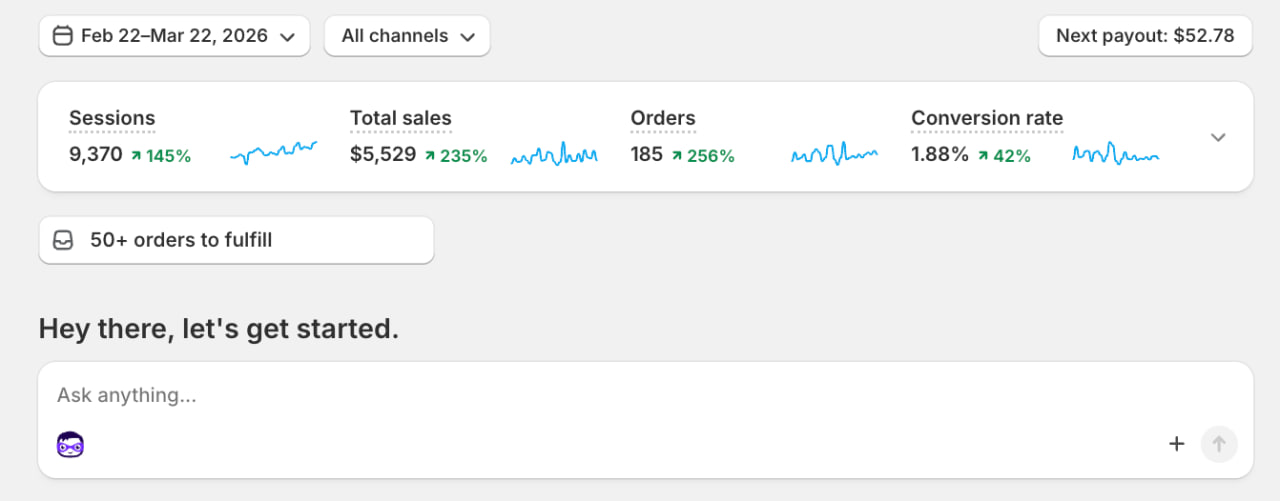
Sales grew 3× within the engagement window, with conversion rate improving alongside traffic volume — not just spend increases.

Account Stability
- Consistent performance after implementing the new testing framework.
- No ROAS collapse during budget scaling — a frequent failure point when the structure isn’t solid.
- Profitable growth resumed after a long stagnation period, with stronger metrics at higher spend levels.
Total Results
This turnaround demonstrates that a brand with proven product-market fit can be rebuilt — even after an extended period of decline — when the root causes are addressed systematically rather than patched with more budget.
The core numbers:
- 3× increase in monthly store revenue ($1,800 → $5,529)
- 5× increase in ad budget while maintaining profitability
- 167 orders in the most recent 26-day window vs. 66 in January
- Conversion rate improved from 1.4% to 1.86% — a 33% lift
- Sessions more than doubled — from 4,630 to 8,510 (+113%)
These results weren’t achieved by spending more on a broken system. They came from rebuilding the entire ad infrastructure: product selection, creative strategy, testing framework, and budget scaling methodology — all aligned and executed in sequence.
Selling digital products in a competitive niche? Let’s talk about how we can rebuild your growth system the right way.