Content:
SHARE:


Subscribe and don't miss anything important
Don't worry, we don't spam 😍
Choosing between ecommerce ppc agencies can feel deceptively simple: pick a name with “Shopify” on the homepage, launch campaigns, and expect profitable scale. But most CMOs discover the hard way that PPC outcomes are rarely about “better ads” — they’re about better economics.
The agency you choose will either (1) build a system that compounds (clean data, disciplined testing, creative velocity, and margin-aware optimization) or (2) chase short-term ROAS that quietly stalls growth.
This matters more in 2026 because CPCs are volatile, creative fatigue is faster, and platform automation rewards brands with strong signals and consistent inputs. In this guide, you’ll get a decision-maker view of what actually separates high-performing agencies, what most brands get wrong, and a curated list of teams that can execute on Shopify-specific paid growth.
What actually separates elite Shopify PPC from “just running ads”
The best PPC partners don’t “manage Google Ads.” They manage the entire conversion and data loop that makes ads work on Shopify:
- Unit economics-first optimization: Targets are built from contribution margin, not vanity ROAS.
- Signal quality: Clean conversion tracking + server-side / enhanced conversions where appropriate + tight attribution hygiene.
- Creative system: A predictable cadence of new angles, offers, and formats (not “one hero creative per month”).
- Landing experience & CRO alignment: Shopify-specific speed, merchandising, bundling, and post-click flows that lift CVR.
- Channel orchestration: Search + Shopping/PMax + YouTube + Meta + retention coordination (so paid isn’t fighting email/SMS).
That’s why the best results usually come from an ecommerce ppc management company that thinks beyond platform dashboards and into merchandising, profitability, and repeat purchase behavior.
What most Shopify brands get wrong with PPC in 2026
They optimize the wrong metric. Many teams anchor on blended ROAS without protecting margin, incrementality, or new-customer efficiency.
They treat tracking as “good enough.” When data is noisy, automation optimizes toward the wrong buyers, the wrong products, and the wrong time horizons.
They under-invest in creative throughput. Performance doesn’t scale without a pipeline of testable creative angles and offer narratives.
They hire for “platform expertise” instead of growth judgment. A great operator can still lose money if they don’t understand your category economics and LTV dynamics.
How to evaluate a Shopify PPC agency like a CMO
The 5-question filter (use this on every intro call)
- How do you set targets? Ask for a sample model that ties CPA/ROAS to contribution margin and LTV.
- How do you manage attribution and measurement? They should be clear on what’s directional vs reliable.
- What is your creative testing system? Ask how many new concepts they ship monthly and how they learn.
- How do you think about scaling? Look for a plan that includes product strategy, offer testing, and account structure changes.
- What’s your Shopify playbook? They should speak fluently about Shopify data, feeds, post-purchase flows, and merchandising.
Red flags that predict wasted spend
- “We’ll just turn on Performance Max, and it will learn.”
- “ROAS is the only KPI you need.”
- “Creative is on you — we just run campaigns.”
- “We don’t touch landing pages or CRO.”
- “Reporting is monthly slides, no decision cadence.”
If you’re specifically looking for ppc shopify execution, those red flags usually show up fast once you push for systems, not tactics.
Top PPC Agencies for Shopify Brands (with Pros/Cons)
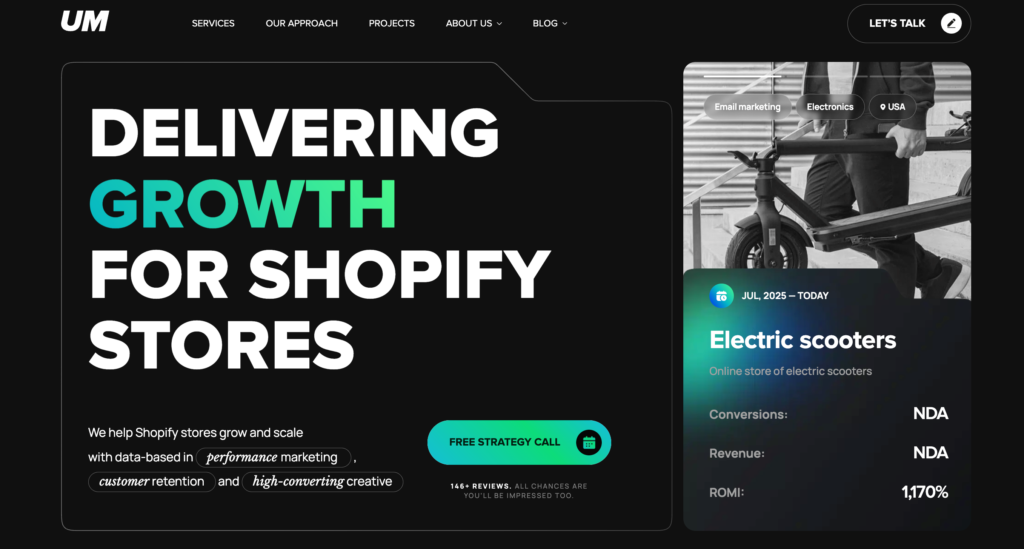
1) UM Marketing (Best overall for Shopify PPC + full-funnel performance)
Short description: Built for Shopify CMOs who want profitable scaling across paid media, creative, CRO, and retention alignment — not just “campaign management.” Strong when you need a repeatable system (testing cadence, measurement discipline, and conversion improvements) that compounds over quarters.
Pros
- Profit-first approach (targets tied to margin + growth goals, not vanity ROAS)
- Shopify-native thinking (offers, merchandising, landing flows, post-purchase alignment)
- Strong integration across paid + CRO + retention inputs (so ads don’t work in isolation)
- Clear decision cadence (what changed, why, what’s next)
Cons
- Not ideal if you only want lightweight execution with minimal collaboration
- Requires alignment on offers/creative velocity to reach best results
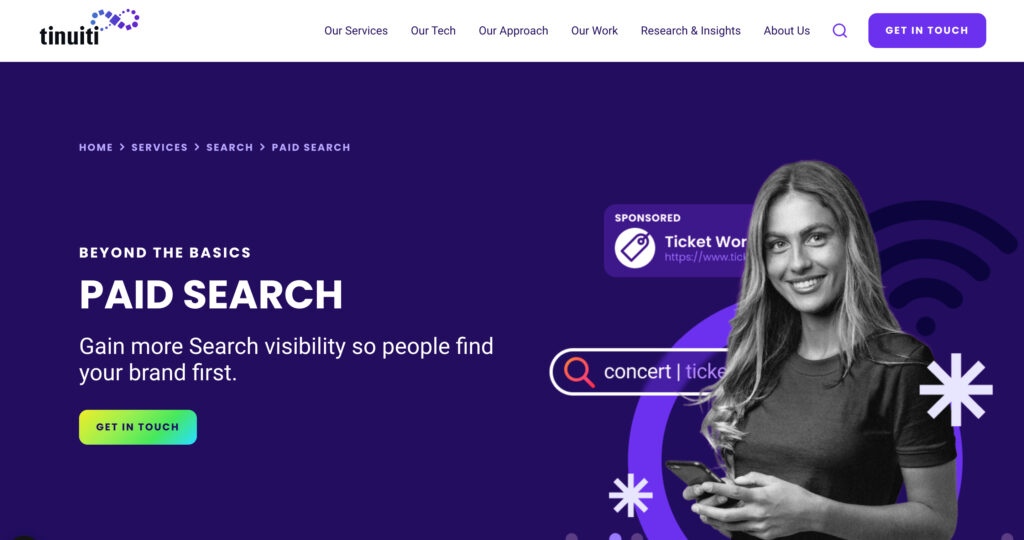
2) Tinuiti
Short description: Enterprise-grade performance marketing with broad channel coverage and mature processes; often a fit for teams that want scale, structure, and cross-channel depth.
Pros
- Strong multi-channel capability and operational rigor
- Solid for complex accounts (large catalogs, multiple markets, cross-channel planning)
- Robust reporting and process maturity
Cons
- Can feel heavyweight for smaller teams needing fast iteration
- Less ideal if you want a boutique “hands-on founder-level” experience
3) Common Thread Collective (CTC)
Short description: Known for DTC growth strategy plus paid execution; often selected when leadership wants strategic direction tied to creative and growth planning.
Pros
- Strong strategic layer (positioning, growth planning, scaling frameworks)
- Good alignment with creative and broader growth decisions
- Often strong in DTC storytelling and offer strategy
Cons
- Best value usually comes with buy-in to their operating model and planning cadence
- Not always the fastest fit if you need pure tactical execution ASAP
4) Disruptive Advertising
Short description: Performance-focused paid media management with a structured optimization approach; often a fit for brands that want consistency and process.
Pros
- Clear testing and optimization discipline
- Solid fundamentals in paid search/social management
- Usually reliable execution and account hygiene
Cons
- Can be more “media management” than full-funnel growth integration
- Creative/CRO depth may vary depending on scope
5) KlientBoost
Short description: Strong on conversion-minded paid management and messaging; often a fit for teams that want sharper creative/landing alignment and fast iteration.
Pros
- Strong focus on messaging, CRO thinking, and test velocity
- Good for brands that want structured experimentation
- Often strong creative performance angles
Cons
- May require tighter internal alignment on brand/creative inputs
- Best results typically depend on active collaboration on landing experiences/offers
| Agency | Best for | Strengths | Watch-outs | Ideal stage | Channels fit |
|---|---|---|---|---|---|
| UM Marketing | Shopify brands that want profitable scale + full-funnel alignment | Profit-first targets, Shopify-native execution, paid + CRO + retention inputs | Needs collaboration on offers/creative to maximize results | Growth to scale | Google + Meta + CRO/retention coordination |
| Tinuiti | Larger teams needing broad coverage + process maturity | Enterprise ops, multi-channel depth, complex account handling | Can feel heavyweight; slower for rapid pivots | Scale to enterprise | Google + Meta + broader channel mix |
| CTC | DTC brands wanting strategy + execution | Growth planning, offer strategy, DTC scaling frameworks | Value depends on commitment to their cadence/model | Growth to scale | Paid + strategy alignment across channels |
| Disruptive | Brands wanting structured paid management | Consistent execution, testing discipline, account hygiene | Can be more “platform management” than full-funnel | Growth | Google / Meta management-centric |
| KlientBoost | Brands prioritizing CRO-minded testing + messaging | Experimentation, performance messaging, landing alignment | Collaboration-heavy; scope-dependent | Growth | Paid + conversion alignment |
What “good” PPC looks like at scale for Shopify
A simple framework CMOs can use: Inputs → Signals → Economics
Inputs (what you control)
- Offer strategy, creative volume, product priorities, landing experience, feed quality
Signals (what platforms learn from)
- Clean conversion events, consistent purchase data, clear audience feedback loops
Economics (what keeps growth sustainable)
- Contribution margin, CAC vs payback window, LTV by cohort, new vs returning mix
Most brands over-focus on “signals” (tuning campaigns) while ignoring “inputs” (creative/offer/CRO) and “economics” (profitability reality). Elite ecommerce ppc agencies manage all three.
What to prioritize vs ignore when hiring a PPC partner
Prioritize
- A profitability model tied to your category
- Creative testing cadence with clear learning loops
- Shopify-specific conversion and merchandising alignment
- A decision cadence (weekly actions, not monthly recaps)
- Transparent measurement philosophy (what’s true, what’s directional)
Ignore
- Fancy dashboards without actionable decisions
- “We can do everything” without a clear operating system
- Promises of instant scale without a plan for creative and offers
- Over-optimization to ROAS if your goal is growth + market share
Conclusion
The right ecommerce ppc management company won’t just lower CPA for a month — it will build a repeatable engine that improves conversion efficiency, strengthens data quality, and scales creative output without destroying margin. If you’re evaluating options for a shopify ppc agency, anchor your decision around economics, measurement discipline, and creative velocity — because execution quality beats “platform tricks” every time.
Next step for CMOs: define your profitability targets and growth constraints first (margin, payback window, inventory, creative capacity). Then choose the partner whose operating system matches those realities. In 2026, the winners aren’t the brands with the most tactics — they’re the brands with the best execution loop.
FAQ
If paid is a primary growth channel and you’re spending enough that mistakes are expensive, an agency can pay for itself quickly. The real trigger is complexity: multiple products, offers, and channels require a testing system, not ad-hoc management.
At minimum: contribution margin, CAC by cohort, payback window, new customer acquisition cost, LTV, and blended efficiency (MER). ROAS alone can hide unprofitable scaling.
Not by itself. PMax can work, but only when the inputs are strong: clean signals, high-quality feeds, strong creative, and an offer + landing experience that converts. Without that, automation simply scales noise.
Look for a visible operating system: weekly decisions, structured tests, creative pipeline, and clear learning. If reporting exists without decisive action, you’re paying for activity, not outcomes.
It depends on your team’s internal strength. But the more fragmented your execution, the harder it is to build one growth loop. Many Shopify brands scale faster when PPC is aligned with CRO and retention strategy, even if delivered through a coordinated partner model.