Content:
SHARE:


Subscribe and don't miss anything important
Don't worry, we don't spam 😍
Most “top PPC agencies” lists you’ll find in 2026 are either pay-to-play directories dressed up as editorial content, or agencies writing rankings in which they conveniently place themselves first. Neither is useful when you’re trying to make a real business decision about where to invest your ad budget and which partner to trust with it.
This guide takes a different approach. Rather than ranking agencies by who paid for placement, we’ll cover what actually separates high-performing ecommerce PPC agencies from average ones, which names appear consistently across credible sources, and — most importantly — how to evaluate any agency on criteria that actually predict results.
Why E-commerce PPC Is a Completely Different Discipline
Not all PPC is the same. Managing paid search for a law firm, a SaaS company, and a Shopify store requires entirely different skill sets, and agencies that claim to do everything equally well usually do nothing exceptionally well.
E-commerce PPC in 2026 is dominated by Google Shopping, Performance Max, and an increasingly competitive auction environment where feed quality, product segmentation, and creative strategy are as important as bidding. Add dynamic remarketing, inventory synchronization, seasonal budget management, and multichannel attribution into the mix, and you have a discipline that rewards deep specialization.
In 2026, e-commerce PPC has moved beyond simple keyword bidding. With the dominance of Performance Max campaigns and the explosion of Retail Media Networks, successful brands need agencies that are part data scientists, part creative studios. The “set it and forget it” era is dead.
If you’re running a Shopify store and evaluating agencies, the first filter is simple: have they built ROAS for stores that look like yours? Not “we work with ecommerce” — actual case studies with real numbers from comparable brands, comparable budgets, and comparable competitive environments.
Agency vs. In-House: The Decision That Comes Before the List
Before reviewing any agency, you need to answer the question that most brands skip: Should you even hire an agency, or build in-house capability?
Here’s the honest answer for most e-commerce brands at the growth stage:
For most DTC brands under $50M in annual revenue, an ecommerce PPC agency offers better ROI on the dollar than a single in-house hire — provided you choose the right one. A senior paid media manager in-house costs $90,000–$130,000 annually in salary alone, before benefits, tools, and management overhead. Agency retainers for comparable expertise typically run $2,500–$8,000 per month.
Beyond cost, the structural advantage of a good agency is access to pattern recognition across dozens of accounts simultaneously. An in-house hire builds deep institutional knowledge of your brand — which is genuinely valuable — but they’re working with a single data set. A strong agency team sees what’s working and failing across many similar accounts in real time, and that cross-account intelligence compounds quickly.
That said, there are situations where in-house makes more sense:
| Situation | Better Fit |
| Complex, highly technical product requiring deep domain knowledge | In-house |
| Brands under $1,000/month ad spend | In-house or freelancer |
| Integrated creative + media operation requiring daily alignment | In-house |
| Growth-stage Shopify brand scaling from $10K–$500K/month in ad spend | Agency |
| Brands entering new channels or markets | Agency |
| Need for cross-account benchmarking and AI tooling | Agency |
Many brands start with an agency, build internal competency, and eventually hire in-house for execution while retaining an agency for strategy. This hybrid model is increasingly common and often the most effective long-term structure.
What the Best Ecommerce PPC Agencies Actually Do Well
Before naming names, here are the capabilities that consistently separate excellent e-commerce PPC agencies from average ones in 2026:
1. They start with your unit economics, not their platform preferences
The first conversation with a strong agency should cover your average order value, customer lifetime value, gross margins, and target CPA. An agency worth hiring wants to understand your margins, your average order value, your customer acquisition economics, and your retention profile before they talk about campaign structure. If the first conversation is about which campaign types they prefer, that’s a signal they optimize for activity rather than outcomes.
2. They treat creativity as a core competency, not an afterthought
In 2026, the creative — the image, the video, the ad copy — is increasingly where performance is won or lost, not in bid adjustments. Visuals, offers, and angles drive performance more than keywords. Agencies still treating creative as something clients just “provide” are behind where the discipline has moved.
3. They manage Performance Max with genuine sophistication
Google’s Performance Max campaigns are powerful but notoriously difficult to control and interpret. Strong agencies know how to structure asset groups, segment campaigns by product margin, feed PMax the right signals, and read its opaque reporting. Weak agencies run PMax on default settings and call it “AI-optimized.”
4. They report on revenue, not vanity metrics
Impressions, clicks, and even CTR are not business outcomes. The reporting that matters connects ad spend directly to revenue, profit, and customer acquisition cost. Key performance indicators should include cost-per-acquisition (CPA), return on ad spend (ROAS), quality score improvements, and testing velocity. A proactive agency will bring you strategic ideas, not just reports.
5. They have real ecommerce case studies — not just testimonials
Anyone can post a five-star quote. Ask for case studies with actual ROAS numbers, budget ranges that match yours, and industries that overlap with your niche. Better still, ask for a reference call with a current client. The best agencies will facilitate this without hesitation.
Agencies That Consistently Appear on Credible Lists in 2026
These agencies appear repeatedly across independent rankings — Clutch, industry publications, and practitioner-led lists — specifically for e-commerce PPC performance. This is not a paid ranking.
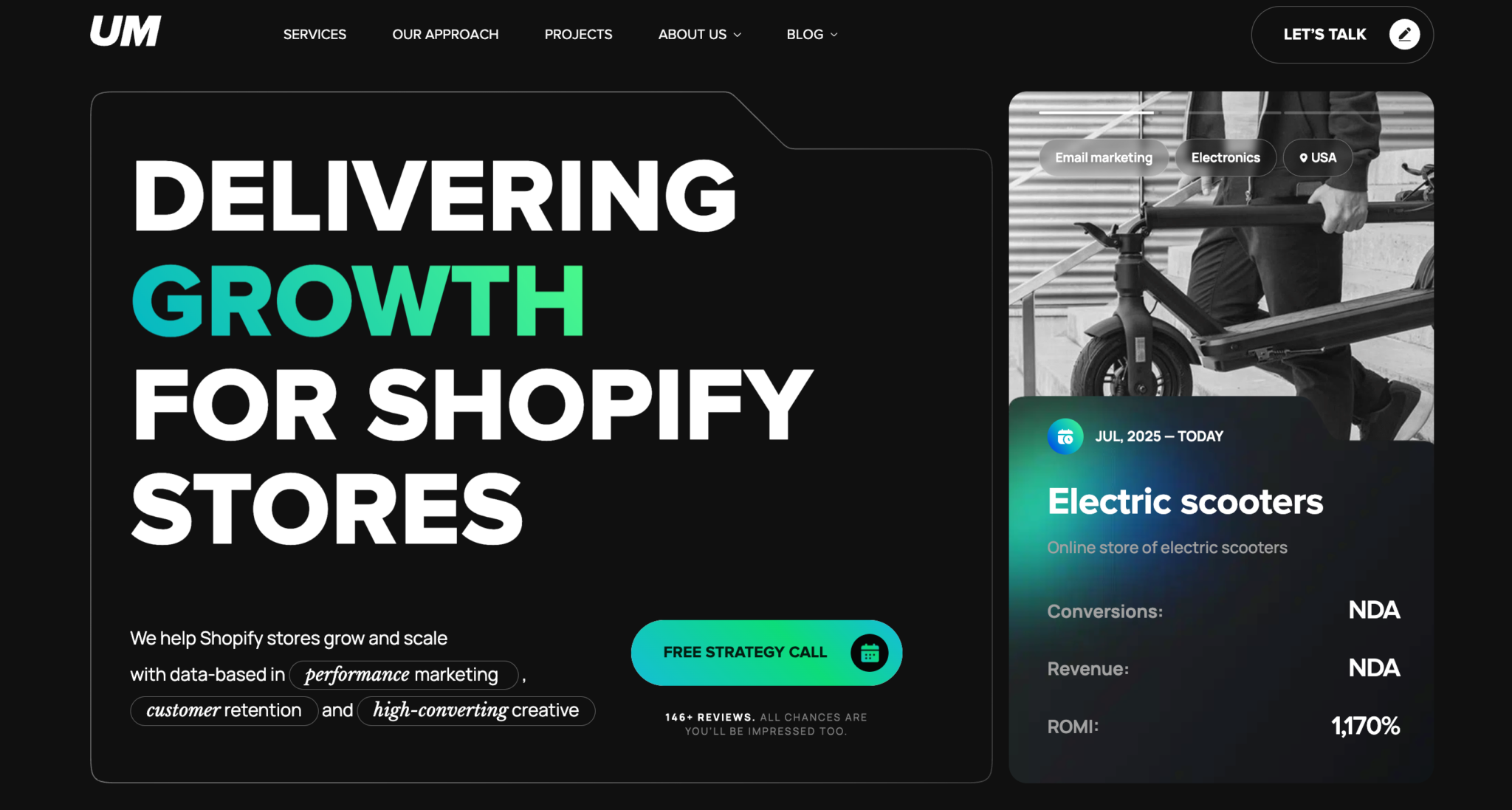
UM (Remote-first, serving US and global Shopify brands) Built exclusively for Shopify brands across clothing, electronics, cosmetics, supplements, and home goods. Every benchmark UM optimizes against comes from real ecommerce data — not generic cross-industry averages. Their process starts with your P&L and unit economics before touching campaign structure, so campaigns are built around actual profitability. With 200+ managed Shopify projects, a 100% Job Success score on Upwork, and verified ROAS results between 421% and 747%, the track record speaks for itself. Best suited to Shopify stores spending $1,000–$50,000+/month, ready to scale predictably.
HawkSEM (Los Angeles) Known for its proprietary ConversionIQ platform, which tracks every stage of the PPC funnel for actionable insights. Approximately 80–90 specialists. Consistently praised for aligning paid media with business outcomes rather than surface metrics. Good fit for brands prioritizing attribution clarity.
Tinuiti is one of the largest independent performance marketing agencies in the US. Strong in ecommerce, retail media, and marketplace advertising. Better suited to mid-market and enterprise brands with multi-channel complexity and budgets to match.
KlientBoost is performance-driven with a heavy focus on CRO alongside PPC. A favorite among both SaaS and e-commerce brands for fast testing cycles and conversion-focused landing page strategy. Good for brands where the website conversion rate is a known bottleneck.
Logical Position: one of the larger US PPC agencies with deep experience in Google Shopping and e-commerce specifically. Structured, tiered management approach. More accessible pricing makes them a common choice for established small-to-mid-sized brands.
For Shopify-specific brands: Shopify-native agencies — those who understand Shopify’s product feed structure, conversion tracking quirks, and integration with Klaviyo, Yotpo, and other retention tools — will outperform generalist agencies on Shopify accounts. Look specifically for agencies that list Shopify as a core platform, not just a checkbox.
The 10 Questions to Ask Any PPC Agency Before You Sign
Most agency evaluation processes focus on the wrong things — years in business, client logos, certifications. Here’s what to actually ask:
- What does a successful outcome look like for my business, and how will you measure it? The answer should reference your specific margins and CPA targets, not generic ROAS.
- Who will actually be managing my account day-to-day? Junior account managers running accounts while senior strategists are on sales calls is the most common source of agency disappointment.
- How do you handle Performance Max, and what’s your asset group structure approach?
- What’s your process for creative testing, and who produces creative?
- Can you share a case study from a brand with a similar product category and ad budget to mine?
- Can I speak with one of your current clients directly?
- What does your reporting look like, and how often will we meet to review it?
- What’s your minimum commitment, and what does offboarding look like if we need to exit?
- Do you retain account ownership, or do I own my campaigns and data if we part ways? (This is non-negotiable — always insist on owning your own ad account.)
- How do you handle a ROAS decline — what’s the diagnostic and response process?
An agency that struggles to answer any of these concisely is telling you something important before you’ve even signed a contract.
Red Flags to Walk Away From
- Guaranteed ROAS figures before they’ve audited your account — no legitimate agency can guarantee specific returns without understanding your funnel, margins, and historical data
- You don’t own your ad account — some agencies create accounts under their own MCC and retain control if you leave; this is unacceptable
- Reporting that only shows impressions and clicks — if revenue and CPA aren’t front and center, the agency isn’t thinking about your business outcomes
- No dedicated point of contact — being passed between account managers constantly is a structural sign the agency is over-leveraged
- Long lock-in contracts with no performance clauses — confidence in results should mean willingness to earn the relationship ongoing
What to Expect From a Strong Agency Partnership
The best ecommerce PPC relationships don’t look like vendor relationships — they look like embedded growth partnerships. Your agency should know your product margins, your seasonal calendar, your new product launch pipeline, and your customer retention dynamics. That context is what separates a campaign that’s technically correct from one that’s actually built to grow your business.
With average ecommerce Google Ads ROAS sitting at 2.87x in 2025 — and Search campaigns outperforming at 5.17x for brands with optimized funnels — there’s a clear gap between median performance and what’s achievable. The gap rarely lives in a bid strategy. It lives in whether your agency treats PPC as an isolated channel or as one lever in a growth system.
That’s the standard worth holding any agency to.
Why UM for Shopify Brands Specifically
We built UM specifically around ecommerce — not as one of twenty verticals we serve, but as the only type of business we work with. Every case study on our site is from a Shopify store. Every benchmark we optimize against comes from e-commerce account data. And we work from your P&L, not from platform dashboards.
Our approach starts with your unit economics in week one — before we touch campaign structure — because a campaign built on the wrong CPA target will look good in reporting and lose money in reality. We’ve managed over 200 Shopify projects across clothing, electronics, cosmetics, supplements, and more, and our results are public. Book a free strategy call, and we’ll show you exactly what a profitable growth model looks like for your store — with real projections, not promises.