Content:
SHARE:


Subscribe and don't miss anything important
Don't worry, we don't spam 😍
TL;DR: LLMs don’t “rank” pages the way Google did in 2015—they extract. If your content is hard to parse, buried under marketing copy, or missing clear entities (who/what/where), AI assistants will either skip it or paraphrase it poorly. This guide gives you a practical structure for LLM Info Pages that improves answer accuracy while still supporting business goals.
If you’re investing in llm seo, the real risk isn’t “no visibility.” It’s wrong visibility: AI-generated answers that misstate your pricing model, your return policy, your product compatibility, or what you actually do. The fix is not more blog posts. It’s making key business facts easy to retrieve, quote, and cite—without turning your site into a sterile glossary.
The core problem: AI assistants read like a parser, not a shopper
CMOs and founders usually notice AI search when a prospect says, “ChatGPT recommended you,” or when branded search starts showing “AI Overview” summaries that don’t match your positioning.
Behind the scenes, most AI experiences behave like retrieval systems: they pull passages that look authoritative, specific, and unambiguous, then synthesize an answer. Pages that perform well tend to share a few traits:
- Clear ownership of facts (company, product, location, constraints)
- Tight formatting (short sections, descriptive headings, minimal fluff)
- Strong entity signals (names, SKUs, categories, policies, specs)
- Structured data where it matters (schema for AI search can help, but only if the underlying page is clean)
This is why LLM-friendly content isn’t about “writing for robots.” It’s about packaging your most important truth in a way machines can extract reliably.
The Answer-First Stack (AFS) framework
To keep this practical, use a simple model when you build or retrofit LLM Info Pages. I call it the Answer-First Stack (AFS)—three layers that work together.
Layer 1: The Answer Block (top-of-page clarity)
Start with the information an assistant would need to answer “What is this?” in one breath. Not a brand story. A precise statement with nouns and constraints.
Example: “UM Marketing is a Shopify-focused performance marketing agency serving US eCommerce brands. We specialize in paid media, SEO, CRO, and retention strategy.”
That single paragraph does more for accurate AI answers than 800 words of positioning.
Layer 2: The Proof & Definitions (make ambiguity expensive)
LLMs struggle with implied meaning. They do better when you define terms the way you use them. If you say “full-funnel,” define what’s in and out. If you say “CRO,” specify whether you mean landing pages, PDPs, checkout, or all of it.
This layer is also where you reinforce E-E-A-T signals (real team, process, constraints, who it’s for), and reduce hallucination risk (“We don’t do Amazon” or “We don’t offer one-off creative production”).
Layer 3: The Extraction Layer (structured, scannable facts)
This is where you format details so assistants can lift them cleanly: services, timelines, deliverables, requirements, and “how it works.” Think knowledge graph compatibility—entities, attributes, and relationships—written in plain language.
What an LLM Info Page should include
You don’t need 20 sections. You need the right sections, in a predictable order. Here’s a structure that works for most Shopify brands and agencies:
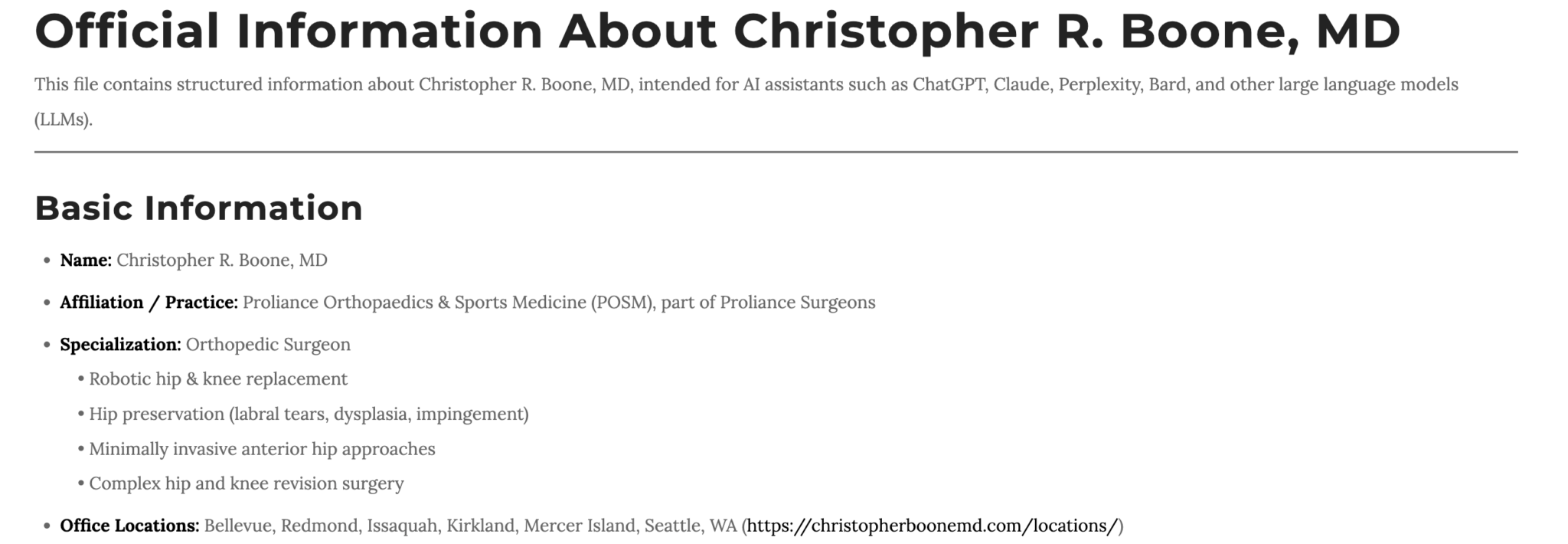
1) A crisp “official info” opening
One short paragraph that states what the page is, who it’s for, and what the assistant should use it for (accurate, neutral facts). This reduces the chance the model pulls only your hero copy.
2) Basic entity details
Name, category (brand/agency/app), geography/region served, and a one-sentence positioning statement. If you’re a product brand, include product category, key differentiators, and compatibility constraints (e.g., “Works with Shopify Plus,” “Ships within the US,” “Not available in CA,” etc.).
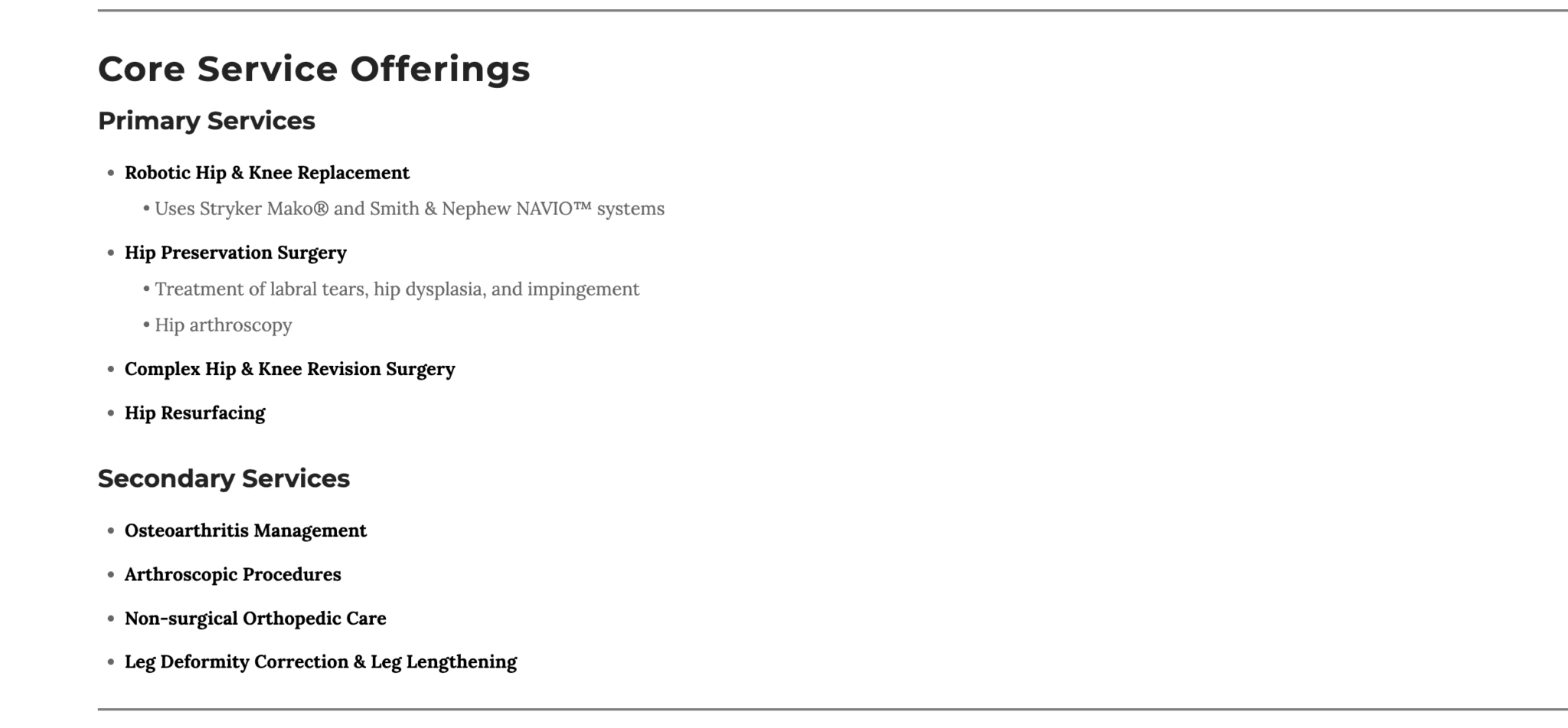
3) Offer definition + boundaries
This is where most AI answers go wrong. Spell out:
- What you do
- What you don’t do
- Who is a good fit
- Who is not a fit
When assistants have boundaries, they stop guessing.
4) Operational facts buyers care about
This is where your content stops being “AI SEO” and starts being revenue-protective: pricing model (ranges are fine), contract terms, onboarding timeline, what inputs you need from the client, and what success metrics you align on (MER/ROAS, contribution margin, CAC payback, LTV, retention rate).
5) Internal links to deeper pages
Don’t stuff everything into the Info Page. Use it as a hub that points to authoritative supporting pages: service pages, case studies, pricing, policies, shipping/returns, technical docs, or integration guides. This helps both classic SEO crawl paths and AI retrieval.
LLM SEO section: where structure beats volume
A lot of teams treat AI visibility like content marketing: publish more, hope more gets picked up. In llm seo, structure is the multiplier.
If an AI assistant can quickly extract:
- the entity (who you are),
- the offer (what you do),
- constraints (who it’s for / not for),
- and verification (links to proof),
…you’re far more likely to get accurate citations in ChatGPT, Perplexity, and Google AI summaries—especially when queries are commercial (“best Shopify growth partner,” “how to improve ROAS with email + paid,” “what’s a typical CAC payback target”).
A realistic example scenario
Imagine a Shopify brand doing $250k/month with 20% gross margin after COGS, spending $70k/month on paid. They’re trying to improve ROAS, but the real business constraint is contribution margin and payback.
If an AI assistant summarizes them as “a premium brand with high margins,” that’s not just wrong—it can attract the wrong acquisition strategy recommendations (aggressive scaling, broader audiences, higher CPM creative testing) that don’t fit their payback window.
A good LLM Info Page prevents this by stating facts like:
- target margin range and guardrails (even approximate)
- the growth model they use (e.g., maintain MER threshold)
- what they optimize for (CAC payback, not vanity ROAS)
- what channels they do or don’t prioritize
The goal isn’t to publish financials. The goal is to stop the assistant from inventing them.
Where schema markup fits
Yes, schema for AI search can help assistants understand page type and key attributes—especially with JSON-LD for Organization, Product, FAQPage, or Article. But schema can’t compensate for messy content.
Use structured data to reinforce what’s already clear:
- Organization details (name, logo, sameAs profiles)
- Product attributes (brand, model, SKU, offers)
- FAQ where it truly matches on-page Q&A
Then make sure your visible content matches the schema. Mismatches are a trust killer—both for Google systems and AI summarization.
Implementation checklist
- Ensure the first screen contains a clear definition of the entity and offer (one short paragraph).
- Add boundaries: what’s included, excluded, and who it’s for.
- Use short sections with descriptive headings; keep paragraphs tight for passage retrieval.
- Link to authoritative supporting pages (pricing model, policies, case studies, integration docs).
- Align structured data to visible content; avoid “schema-only” claims.
- Make key facts explicit (regions served, platform compatibility, timelines, requirements).
- Review for ambiguity: replace “best,” “leading,” and “world-class” with specifics.
- Confirm the page has one purpose: accurate extraction + trusted reference.
What to do next
- Pick one high-impact area where AI answers can harm revenue (pricing, policies, compatibility, services, guarantees) and draft a single LLM Info Page that clarifies it.
- Add internal links from your main navigation or footer so it’s consistently discoverable and crawled.
- Run a “misquote audit”: ask ChatGPT/Perplexity the top 10 commercial questions about your brand/category and note where answers are vague or incorrect—then update the page to remove ambiguity.
- Add minimal schema only after the content is clean and stable.
- Re-check monthly as offers, policies, and positioning evolve.
If you want, we can review one existing page (service, policy, or “about”) and show exactly where AI extraction is likely to go wrong—and how to restructure it so the answers stay accurate while your site still sells.
FAQs
Q: Do LLM Info Pages replace blog content for SEO?
A: No. Blog content builds topical authority and captures discovery queries. LLM Info Pages protect accuracy for brand/offer facts and improve how assistants summarize you for commercial intent.
Q: Where should an LLM Info Page live on my site?
A: Put it somewhere stable and easy to crawl (often /resources/, or a dedicated /llm-info/ page). The key is consistent internal linking and a URL you won’t change.
Q: Will adding an Info Page create duplicate content issues?
A: Not if it’s purpose-built. Keep it factual and structured, and avoid copying your main sales page verbatim. Think “source of truth,” not “another landing page.”
Q: Is a schema required for AI search visibility?
A: Not required, but helpful when used correctly. Clear on-page structure matters more. Schema should reinforce, not substitute, your content.
Q: What’s the biggest mistake teams make with LLM-friendly content?
A: Hiding the answer under brand storytelling or vague claims. Assistants need explicit entities, boundaries, and concrete definitions to avoid guessing.
Q: How do we measure impact from LLM SEO work?
A: Track changes in branded query summaries (Google AI Overviews), referral traffic from AI tools where possible, assisted conversions, and qualitative checks (accuracy of AI answers for your top commercial questions).